

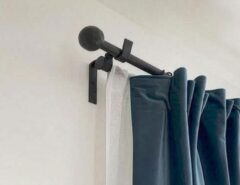
The mechanics of a double curtain pole are straightforward enough. Two poles, two layers of fabric, one set of brackets. But the aesthetic possibilities that open up once you move beyond a single layer are considerable, and getting the details right makes the difference between a window that looks dressed and one that looks designed.
This post covers the visual and practical side of working with a double curtain pole: choosing finials and accessories, coordinating your pole’s finish with the rest of the room, and measuring accurately before you order.
A More Refined, Layered Interior Look
A double curtain pole adds genuine depth to a window treatment, creating a sense of considered layering that a single pole simply cannot achieve. The sheer behind the main curtain introduces a second texture, a softer diffusion of light, and a visual richness that reads as intentional rather than accidental.
Crucially, each layer hangs cleanly in its own space. There is no competition for room on the rings, no fabric snagging against fabric, and no awkward bunching when one curtain is drawn and the other is not. The result is a window that looks properly dressed: balanced, elegant and cared for.

Coordinating Finishes Across a Room
A curtain pole is not a standalone object. It is part of a wider visual language, and matching the pole’s finish to other metalwork in the room creates a cohesive scheme that feels resolved rather than assembled.
A matt black wrought iron pole will sit naturally alongside black iron door furniture and forged light fittings. A beeswax or natural iron patina finish lends warmth to period interiors, complementing aged brass hinges, antique bronze handles and stone or timber surrounds. The key is consistency: when the metalwork in a room shares a common finish or tone, the eye reads the space as considered rather than coincidental.
Choosing a Finish for Your Setting
- Matt black: suits contemporary and industrial interiors, works well with dark ironmongery, slate and dark-stained timber.
- Natural iron patina: develops warmth over time, sits comfortably in period, farmhouse and country settings.
- Beeswax: a softer, slightly warmer tone, sympathetic to listed buildings and heritage interiors.
Finials and Accessories
A well-chosen finial transforms a curtain pole from functional hardware into a design statement. The convention on a double pole is to use decorative finials on the front pole, where they are visible, and discreet stud or button caps on the back pole, keeping the secondary layer understated.
Coordinating rings, holdbacks and tiebacks complete the picture. Wrought iron holdbacks, fixed directly to the wall, are a particularly handsome alternative to fabric cord tiebacks and carry the additional advantage of being entirely cord-free, which is also the recommended approach in households with young children.

Tiebacks and Holdbacks: What to Consider
A tieback, whether fabric, cord or chain, gathers the curtain loosely and holds it to one side. A holdback is a fixed wall fitting that the curtain loops behind. Holdbacks tend to give a cleaner, more architectural look and work especially well with heavier fabrics that benefit from a firm anchor point. Learn more about curtain holdbacks and their benefits in our guide.
For a wrought iron double pole, forged iron holdbacks in a matching finish are the natural choice. They add a sculptural element to the window treatment and, unlike fabric tiebacks, require no maintenance.

Measuring for a Double Curtain Pole
Accurate measurement is the foundation of a good installation. For a double pole you will need three key figures: the width of the pole, the height at which it will be mounted, and the projection from the wall.
Pole Width
The pole should extend beyond the window frame on each side, typically by 15 to 20 cm, to allow the curtains to stack clear of the glass when open. This maximises the amount of light that enters the room and gives the window a generous, well-proportioned look. In narrower alcoves or recessed windows, this overhang may need to be reduced, but never to zero.
Mounting Height
The higher the pole is mounted above the window, the taller the curtains appear and the more light can enter above the frame. A good general rule is to mount the pole 15 to 20 cm above the top of the window opening, or higher still in rooms with generous ceiling heights where floor-to-ceiling curtains are the aim.
Projection from the Wall
A double pole needs sufficient projection to clear any window hardware, handles, hinges or sill projections. Check that the brackets you choose provide enough depth for both poles to sit clear of each other and of anything between the curtain and the glass, including blinds or plantation shutters if these are already in place.
Measuring in Older Properties
In older properties, settlement can introduce surprising irregularities. Walls may not be perfectly plumb, window openings may not be perfectly square, and the two sides of a window can differ in height by more than you might expect. Always measure both sides independently and work from the higher of the two figures when setting the pole height.
A Note on Listed Buildings
Curtain poles are generally treated as minor internal work and do not normally require listed building consent. This makes a double pole one of the few meaningful upgrades available to owners of listed buildings without navigating the consent process.
Where drilling into original stonework, mullions or historically significant plasterwork is unavoidable, it is always worth a conversation with your local conservation officer before proceeding. In most cases, the work will be straightforward, but it is better to check in advance than to discover a restriction after the fact.
Bringing It All Together
A double curtain pole done well is the result of small decisions made carefully: the right finish for the room, finials that earn their place, holdbacks that complement rather than compete, and measurements taken on both sides of the window before a single bracket is ordered.
Wrought iron, with its handmade character and ability to carry genuine weight, is the material that rewards this kind of care most generously. It does not call attention to itself, but it is always visible to those who look: in the way the curtains fall, the solidity of the fixing, and the unhurried patina that only comes with time. Take a look at the Made by the Forge take on the double curtain pole and order your made-to-measure pole if you’re looking to give your windows that polished, complete look.


Leave a Reply
You must be logged in to post a comment.