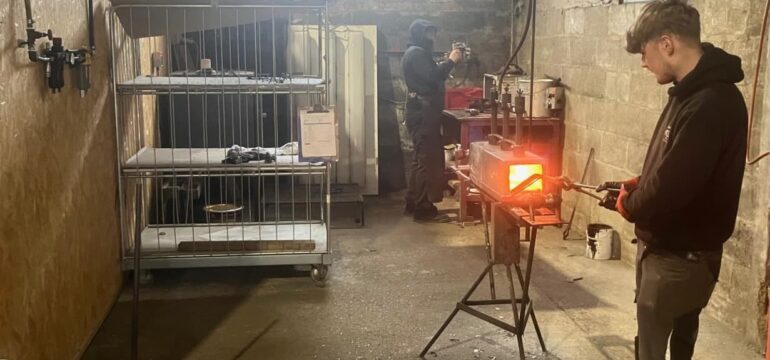

Walk into the Made by the Forge workshop in Suffolk and you will hear it before you see it. The ring of hammer on iron, the hiss of metal meeting water, the rhythmic focus of skilled hands at work. It is a sound that has echoed through British workshops for centuries. And it is a sound we are determined to preserve.
A Craft with Deep Roots
Blacksmithing is one of the oldest trades in human history. Long before mass production changed the way we make things, blacksmiths were at the centre of every community, forging the tools, hardware, and fittings that homes and workshops depended on. The skills required, reading the heat of metal by colour, knowing exactly when to strike, understanding how iron moves and responds, cannot be learned from a manual. They are passed down, person to person, through years of practice and mentorship.
In Britain, that tradition runs particularly deep. From the great ironwork of the Victorian era to the rural forge that served every village, blacksmithing shaped the built environment around us. Much of what we consider beautiful in older homes, the wrought iron gates, the hand-forged curtain poles, the decorative hardware, was made by craftspeople who learned their trade at someone else’s elbow.

The Risk of Losing What We Cannot Easily Replace
Over the last century, industrialisation and cheap imports have steadily eroded the market for hand-forged ironwork. Many forges closed. Apprenticeships became rare. The knowledge held by skilled blacksmiths began to disappear with them, not because the skills were no longer valuable, but because the economic conditions that sustained them had changed.
What remains is precious. The ability to take a length of raw iron and transform it, through heat and skill alone, into something beautiful and permanent is not something that can be easily recreated once it is gone. It requires years of practice. It requires someone willing to teach, and someone willing to learn.
What We Are Doing at Made by the Forge
At Made by the Forge, we have always believed that a business like ours carries a responsibility that goes beyond making beautiful products. We are stewards of a craft, and that means actively investing in its future.
That means taking on apprentices and trainees. It means giving young people the time, space, and mentorship to develop real skills at the anvil, not just an introduction to the tools but a genuine grounding in the trade. It means being patient, as good teaching always requires, and understanding that the knowledge we are passing on has taken generations to develop.
It also means being proud of what we do. There is sometimes a tendency to undervalue manual craft in a world that celebrates technology and speed. We want the next generation of blacksmiths to understand that what they are learning is extraordinary. The things they will make will outlast most other objects in a home. They will be used every day, admired, and inherited. That is something worth dedicating a career to.

Rescuing a Legacy: Nigel Tyas Ironwork

Preserving a craft sometimes means stepping in at precisely the moment it is about to be lost. That is exactly what happened with Nigel Tyas Ironwork, a name that had been producing beautiful hand-forged ironwork for more than 25 years.
Nigel Tyas spent more than 25 years building a body of ironwork that was genuinely worth preserving. His designs are considered and carefully proportioned, shaped by a deep understanding of what wrought iron can do and what it should look like in a well-made home. When Nigel retired, he sold the business to two new owners who were eager to carry the work forward. But the realities of running a hand-forged ironwork business are demanding, and ultimately the business went into administration. A quarter century of craft and design came very close to being lost for good.
We stepped in to acquire the Nigel Tyas brand and designs, and we are now working alongside Nigel himself to bring the collection back. That collaboration matters to us a great deal. Nigel’s designs are not simply patterns to be reproduced. They carry his understanding of form, proportion, and the particular quality that only comes from decades of working with iron. We are honoured to be the people who continue them. You can meet the team behind the work on our Meet the Team page.
If you have ever admired a piece of Nigel Tyas ironwork in a home or showroom, the good news is that the collection lives on. Made by hand, in Suffolk, to exactly the standard Nigel always insisted upon.
Why This Matters for Our Customers
When you buy from Made by the Forge, you are not just purchasing a curtain pole or a pan rack. You are supporting a workshop that employs skilled craftspeople, invests in training, and keeps a centuries-old tradition alive in rural Suffolk.
Every piece we make is forged by hand, inspected by the person who made it, and sent out with our lifetime guarantee. That guarantee is only possible because of the skill and care that goes into every item. And that skill is only possible because someone took the time to teach it.
An Invitation
If you are passionate about British craft, traditional skills, or simply the idea that beautiful, lasting things deserve to be made with care, we would love to hear from you. We are always interested in speaking with people who share our belief that the craft of the blacksmith deserves a future as rich as its past.
In the meantime, every order placed with Made by the Forge is, in a small but genuine way, a vote for the continuation of something remarkable. We are grateful for every one of them.


Leave a Reply
You must be logged in to post a comment.