
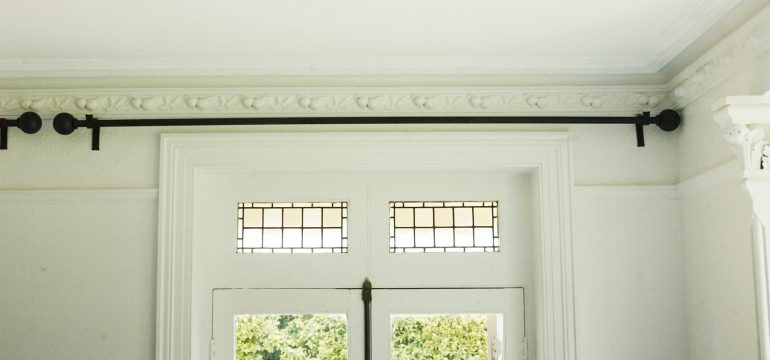

Ordering a bespoke curtain pole is one of the more satisfying home purchases you can make. The process is more personal than buying off the shelf, and the result is a pole that fits your window and your home exactly. A little preparation before you order makes the whole experience smoother and ensures you get precisely what you want.
Here is what to think through before getting in touch.
Your Window Measurements
The starting point for any bespoke pole is the width of the window and the space available either side of it. The pole itself should extend beyond the window frame on each side, typically by 15 to 20 centimetres, to allow the curtains to stack back fully when open and not block the light.
Measure the total length you would like the pole to be, from finial tip to finial tip, and note the window width separately. If you are unsure how far to extend beyond the frame, our team is happy to advise based on your curtain fabric and heading style.
Remember to measure in centimetres, and if possible, measure the space twice before ordering. Read our handy guide on measuring for straight poles as well as more tricky bay windows.
Where Your Brackets Will Fix
Before choosing your bracket style, think about what they will be fixing into. Solid masonry, stud partition walls, and timber frames all require different fixings, and in some cases the type of wall may influence which bracket configuration works best.
If you are fixing into a particularly hard or unusual surface, or if you are unsure about the construction of your walls, it is worth establishing this before ordering. Our standard wall brackets work in the vast majority of situations, but our other styles give additional flexibility for trickier installations.
How Many Brackets You Will Need
As a general guide, a pole up to around 150 centimetres needs two end brackets and no centre support. Between 150 and 250 centimetres, a single centre bracket is usually sufficient. For poles wider than 250 centimetres, or for heavy blackout curtains across any width, additional centre brackets are a wise investment.
Getting the bracket count right from the outset ensures the pole hangs perfectly and stays that way for years.
Your Curtain Style and Fabric
The type of curtain you plan to hang affects several decisions. Heavier fabrics and interlined curtains require a more substantial pole diameter. Eyelet curtains run directly on the pole and need a clean, smooth surface rather than rings. Pencil pleat and pinch pleat curtains use rings, and the number of rings required is approximately one per 10 centimetres of curtain drop, plus one for each end.
If you are buying your curtains and pole at the same time, it is worth thinking through the heading style first, as this will influence both the pole diameter and the ring specification.
Finish and Finial
Both of our finishes, Matt Black and Natural Beeswax, work beautifully in a wide range of interior contexts. Matt Black is clean and contemporary, and sits particularly well with dark or neutral palettes, modern kitchens, and rooms with strong architectural lines. Beeswax reveals the warmth of the iron beneath and suits period properties, natural materials, and rooms with a softer, more relaxed aesthetic.
For finials, our full range is described in detail in our finial guide, but as a starting point: if in doubt, the Cannonball is our most versatile design and suits almost every setting.
Lead Times and Delivery
Because every Made by the Forge pole is made to order, there is a lead time from order to delivery. This varies depending on current demand, so it is worth checking at the time of ordering and planning accordingly, particularly if you have decorators or curtain makers scheduled.
We will always give you a realistic lead time upfront. Our made-to-measure service is personal, and that means honest communication at every stage.


Leave a Reply
You must be logged in to post a comment.