
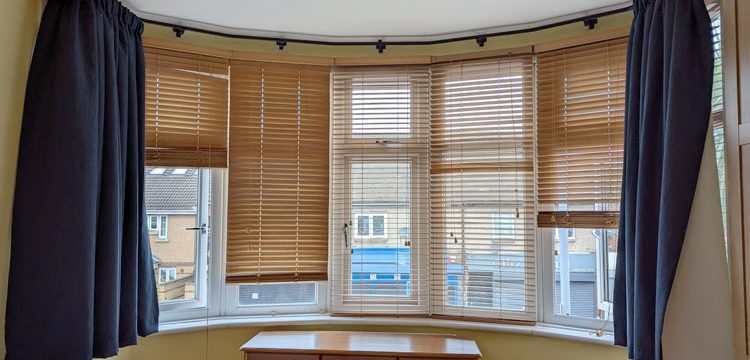

A bay window is often the loveliest feature in a period room, and the first of all bay window curtain ideas is deciding where the curtains go: following the bay round its angles, straight across the front of it, or inside the recess of each window. For most Victorian, Edwardian and cottage bays I would follow the bay, while straight across comes into its own on a wide wall with room either side. Before you choose a pole shape, this guide walks through the look, the light, the draughts, the floor space and whether your curtains will run all the way round, and our made-to-measure bay window poles are all in one place when you are ready.
Three Ways to Hang Curtains in a Bay Window
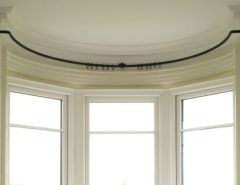
- Curtains that follow the bay. The pole is shaped round a canted or angled bay, a square box bay or a curved bay or bow window, so the curtains travel round with it.
- Curtains straight across the front of the bay. A straight pole runs across the mouth of the bay on the wall or ceiling line, treating the bay as one wide window.
- Curtains for the recess. Each window has its own curtains, hung inside the reveal on a recess curtain pole, so the wall between the windows stays on show.
Follow the Bay or Hang Straight Across?
For most Victorian, Edwardian and cottage bays, follow the bay, with a pole shaped round the angles so your curtains hang close to the glass. The deciding factor is wall space: straight across suits a wide wall with room either side, a window seat or a modern room.
Following the bay keeps the architecture on show, because the curtains trace every angle and the room keeps its bay even when they are drawn, while straight across draws one broad, clean line that can make the window look wider.
| Follow the bay | Straight across | |
|---|---|---|
| Look | Shows off the bay’s shape | One broad line, the window looks wider |
| Light | Curtains rest at the ends, clear of the glass | Curtains pull clear of the whole bay |
| Floor space | The floor stays clear | Space behind the curtains can go unused |
| Draughts | Curtains hang close to the glass | Curtains hang across the bay’s mouth |
| Heavy curtains | Brackets at each corner share the weight | A long span needs a centre bracket |
| How the curtains run | Passing brackets and rings carry them round | One straight run |
Curtains That Follow the Bay
On a 2 bend pole we forged for a canted bay in a Victorian terrace, the sofa stayed tucked up in front of the bay and the curtains drew round behind it every evening. With nothing stacked out across the floor, the bay stays visible and even a modest room feels bigger, and on a street-facing bay the curtains close right round against the glass for privacy at night.
We forge each pole in Suffolk from solid iron bar, shaped to your own measurements. It comes in Matt Black Paint or Natural Beeswax with your choice of finials, and like everything we make it is guaranteed for life as standard.
For three of our windows we wanted a bespoke design incorporating an extra pole for a voile blind and they were able to create this for us. Our two bay windows were a non standard shape (we have a deep window sill) and this too caused them no problems as they just adapted their standard design to fit! I don’t know of anywhere else that can so effortlessly adapt their products to suit their customers. The quality of the workmanship is exceptional and all five poles have fitted perfectly.
Mike Best
Curtains Straight Across the Front of the Bay
A straight pole is simple to fit and suits a very shallow bay too, and when someone mentions a window seat built into their bay, it is usually what we suggest, so the cushions stay put and the curtains close in front of them.
Once the curtains are drawn in the evening, the bay sits outside the curtain line, and because the curtains gather at each end you will need wall space beside the bay. A long span carrying heavy curtains needs a centre bracket, and we add an extra bracket for every 200cm of pole.
For this layout we forge a made-to-measure straight curtain pole to your width, in your chosen finial and finish.
Light Gaps and Draughts
The light gap people tell us about most is the thin strip down each side of the bay, and it usually comes from curtains that stop short of the frame, so give them enough pole and enough width to gather beyond it. Light over the top depends on how high the pole sits, and for a bay with little wall above the window we also make ceiling brackets for our bay window poles.
The English Housing Survey found that 27% of homes built before 1919 had an energy efficiency rating of A to C, well below the share for homes built after 1944, so keeping the warmth in through a big bay of glass is well worth the effort. Heavy curtains help here, as Historic Environment Scotland says heavy, lined curtains can reduce heat loss through a traditional sash window by 14%, and it also advises closing curtains at night to reduce heat loss.
Will the Curtains Glide Round the Corners?
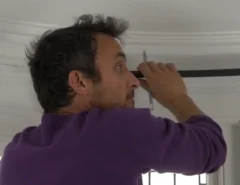
Yes, on a forged bay pole your curtains travel all the way round. At every corner the rings meet a bracket, so we make passing brackets and passing rings as a pair, and each passing ring has a small missing piece that lets it slide over the top of the bracket and carry on round the bend. Before a bay pole is wrapped for its journey, we like to slide a passing ring over each passing bracket by hand, just to feel it run smoothly.
Most bays need five brackets in total, two standard end brackets, two passing brackets and one centre bracket, and larger bays may need four passing brackets. You can see the curtain passing rings at work in our video showing how passing rings work, and Taming the Tricky Bay goes into more detail.
Choosing Curtains That Hang Well in a Bay
Heavy, lined curtains suit a period bay and long winter evenings, and fewer, fuller panels look generous and gather neatly at the ends of the pole. Floor length suits a living room, stopping just above any radiator or window seat beneath the bay.
The NHS says you may find it easier to sleep in a room that is quiet, dark and cool, and for a bedroom bay the Sleep Charity suggests quality, well-lined curtains and a blackout blind, while our post on whether curtain poles can handle blackout curtains covers the weight.
Allow a ring about every 10cm for light and medium curtains and one every 7cm for heavy curtains, with an even number on each curtain. To layer a sheer behind a heavy curtain, use a double pole.
Ideas for Different Bay Shapes
- 2 sided bays sit across a corner, and our 1 bend bay pole follows that single angle.
- 3 sided angled bays, the classic canted bay, take a 2 bend bay pole that turns at both corners, and canted bays in Victorian and Edwardian terraces keep it among the shapes we make most often.
- Square 3 sided bays, often called box bays, have a square bay pole shaped to their right angles.
- 4 and 5 sided bays take our 3 bend and 4 bend bay poles.
- 6 and 7 sided bays take our 5 bend and 6 bend poles, which carry your curtains round every facet.
- Curved bays and bow windows have a curved bay pole forged to the sweep of your curve.
Planning Your Pole Before You Order
Find a helper and measure your bay to the nearest millimetre using our step-by-step guide to measuring a bay window, or watch our video on measuring a 2 bend bay window pole, then choose your shape on our bay window poles page. We guarantee the fit on every bay pole when your measurements are accurate, and if your bay looks unlike any of the diagrams, please send us photos or give us a call and we will happily work it out together.
Frequently Asked Questions
Should Curtains Go Inside or Outside a Bay Window?
Inside suits most period bays, on a pole that follows the bay’s angles so the curtains gather neatly at each end. Outside means a straight pole across the front of the bay, inside the room rather than outdoors, which suits a modern room or a built-in window seat.
How Far Past the Bay Should the Pole Go?
Far enough for your curtains to rest clear of the glass when open, leaving the frame and the daylight free, with the finials ending wherever you choose, because you measure to the point where you want them to finish.
Will Curtains Make a Small Bay Feel Crowded?
A pole that follows the bay keeps a small bay feeling open, because the curtains hang close to the glass and gather at the ends of the pole rather than across the floor, so the space in front of the window stays free for a chair or a sofa.

Leave a Reply
You must be logged in to post a comment.